Working to build a more diverse and inclusive geoscience discipline is both my research focus and personal passion. The motivation for my work is the extreme underrepresentation of people with disabilities in science, and my own personal experiences with ableism. According to the National Science Foundation, the geosciences produce the least number of graduates with disabilities of all STEM disciplines. The heavy emphasis on physically rigorous field work, in both academic preparation and cultural identity, plays a significant role in the exclusion of students with disabilities (Carabajal, Marshall & Atchison, 2017) as well as other underserved identities including People of Color, working students, care-givers and low-income students.
My primary research examines the educational, social and cultural aspects of field learning to take it apart, find the most valuable aspects, eliminate unnecessary historical and cultural barriers (such as the requirement for extreme physical exertion) to develop accessible and inclusive approaches to field learning. Communication technology can be a powerful tool in creating more inclusive field learning opportunities (Marshall, 2018), but many programs lack the resources to use this approach. The Library of Inclusive Field Technology, aka the “LIFT Kit” ensures instructors have access to the tools to incorporate technology-enhanced solutions to inaccessible field settings (PI, NSF Equipment Grant Award #1941497). But inclusion takes more than digital field trips or streaming field activities back to students, it takes thoughtful structuring to develop programs that are accessible, rich, and socially inclusive for students with disabilities (Atchison, Marshall & Collins, 2019).
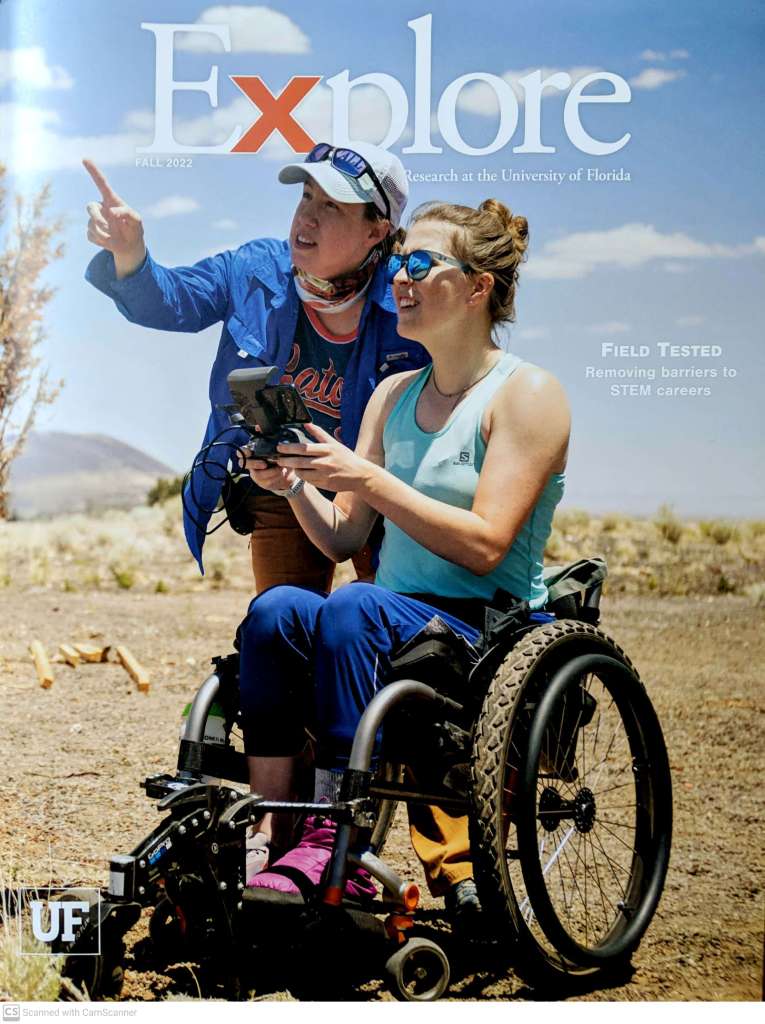
All of these ideas contributed to the launch of the GeoSPACE Project (PI, NSF Award #2023124); a hybrid field course that enables students to get the crucial experiential learning they need in a more accessible format, while developing industry-desired skills such as digital mapping, remote sensing, photogrammetry and project management (Marshall et al, 2022). Mentoring and peer networks during and after the field course supports students in their next professional steps towards graduate school or careers. The program provides students who are rarely offered experiential learning opportunities a place to find community and sense of belonging in the geosciences. GeoSPACE also provides rich a environment to research a variety of topics regarding learning in hybrid, remote and field environments, science identity, the impact of mentoring, the experiences of traditionally marginalized students withing our discipline, and much more.
Beyond field work, there are a host of reasons that people with disabilities struggle to succeed in geoscience including cultural stigma and inaccessible workplaces (Marshall & Thatcher 2019). The planning grant “Classroom to Career: Building a Culture of Access for Geoscientists with Disabilities” brings together a team of Disabled geoscientists from diverse backgrounds to research the experiences of d/Disabled geoscience professionals and build support networks to create more inclusive science workplaces (PI: NSF Award # #2228095).
Across STEM disciplines, there is a growing call for cultural change and professional societies hold significant influence over their respective disciplines. The ASCEND Research Coordination Network (co-PI, NSF Award 2037271), aims to build consensus and coordinate actions to dismantle barriers to across scientific societies. By working with dozens of scientific societies, ASCEND also provides an environment to explore the social “levers” that drive the culture of the geoscience profession.
Selected Publications
Note: The GeoSPACE project produces a significant amount of material. Please see the Resources page on the GeoSPACE website for a full list of resources from that project.
Marshall, A. M. S., Piatek, J.L., Williams, D.A., Gallant, E., Thatcher, S., Elardo, S., Williams, A.J., Collins, T., and Arroyo, Y., 2023 Flexible Fieldwork. Nature Reviews Earth and Environment.
Marshall, A & Thatcher, S., 2020 Creating Spaces for Geoscientists with Disabilities to Thrive. Eos, 100, published online 02 December 2019, in print Jan 2020.
Atchison, C. L., Marshall, A.M, & and Collins, T., 2019. A multiple case study of inclusive learning communities enabling active participation in geoscience field courses for students with physical disabilities. Journal of Geoscience Education.
Marshall, A., 2018. Moving Forward: Overcoming our Ideas About Disability in the Geosciences. Speaking of Geoscience, The Geological Society of America blog.
Carabajal, I.G., Marshall, A.M., & Atchison, C.L., 2017. A synthesis of instructional strategies in geoscience education literature that address barriers to inclusion for students with disabilities. Journal of Geoscience Education. https://doi.org/10.5408/16-211.1
Marshall, A., Connor, C., Kruse, S., Malservisi, R., Richardson, J., Courtland, L., Connor, L., Wilson, J. and Karegar, M.A., 2015. Subsurface structure of a maar-diatreme and associated tuff ring from a high-resolution geophysical survey, Rattlesnake Crater, Arizona. Journal of Volcanology and Geothermal Research. https://doi.org/10.1016/j.jvolgeores.2015.09.006
Students and Mentees
It is an honor and privilege to mentor students in geoscience education work. I am not on the tenure track, so I don’t have a formal lab page to share. But please check out the webpages and work of these amazing researchers!
Current Graduate Student Mentees:
Michael Cox, PhD Student. Supervisor. Projected graduation 2029. Areas of focus: technology enabled field learning, accessible field learning.
McKayla Meier, PhD Candidate. Committee Member. Areas of focus: Planetary geology & virtual field learning.
Previous Student Mentees:
Sarah Lynn Redding, PhD 2025. Supervisor. Focus areas: Education & Geobiology. Dissertation: “Instructor Expectations vs. Student Readiness: Identifying a Missing Puzzle Piece to Geoscience Student Success”
Yesenia Arroyo, Post Baccalaureate Scholar. Mentor/Supervisor 2022-24. Areas of focus: virtual and hybrid learning and technologies, science communication, volcanology.
 Anita M. S. Marshall, PhD